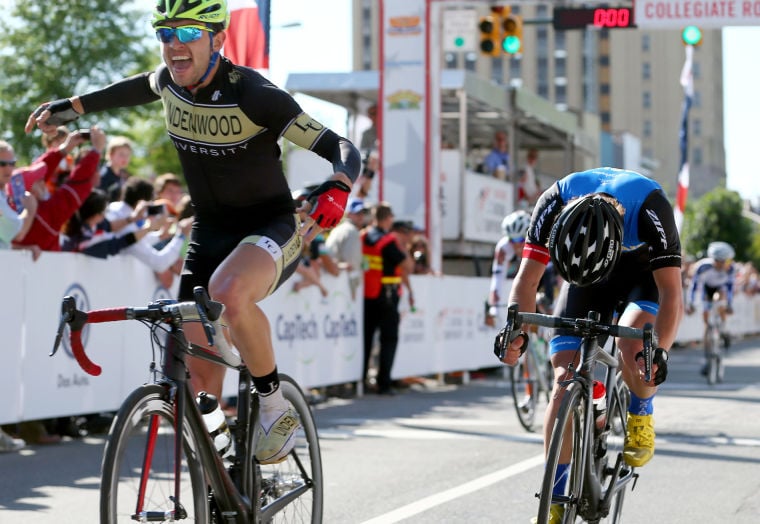
Around the country the road season is wrapping up with most conferences having completed their seasons and crowned individual and team champions. While we are all primarily interested in the performances at the upcoming National Championships, we can also take a moment to speculate as to what Nationals will look like in the 2016-17 season under the new divisional structure.
I have previously speculated about the potential negative consequences of making divisional membership based on program type (varsity vs. club), but now we have some hard numbers to work with. I am relying on the information available at CCN and the conference results that are available as of today.
In my opinion, we can see clear negative outcomes in terms of "National Representation", "Showcasing the Best Teams/Riders", and "Field Composition".
National Representation
Currently there are 16 varsity programs with A riders. These programs are distributed as follows:
Midwest = 3
Rocky Mountain = 4
South Central = 1
Southeast = 8
This means that 6 out of the 10 active conferences will not be represented in the premier division. Further, 50% of the schools will come from a single conference.
Showcasing the Best Teams/Riders
Of the 10 active conferences, 7 of the conference championship winning teams are club programs. While this means that in 3 of the 4 conferences with varsity teams, a varsity team was the strongest team, in one conference (Rocky Mountain) a club team outperformed 4 varsity programs.
Further, only 9 of the 16 varsity programs make the CCN.com's Top 25 Power Rankings. This means 16 of the statistically strongest programs in the country will not be competing in the premier division.
From an individual rider perspective, the split also dilutes the quality of the premier field for both men and women. According to CCN.com's rider rankings, only 24 of the top 100 ranked men are from varsity programs. For the women it is only 39. This means that the majority of the top ranked individual riders will not be lining up to contest the premier division.
Field Composition
On the mens side, only 7 varsity teams are capable of fielding a full squad (6) in the Road Race. The remaining 8 programs can field a grand total of 19 riders. The resulting mens field will be extremely small and/or imbalanced (large teams dominating small teams).
For the women it is even more problematic. There are only 12 varsity programs that can field a female competitor at Nationals. Of these 12, only 5 can field the full 6 in the road race (an additional team, Brevard, can field 5 riders). If you were to include club programs, a full 12 programs would be able to field 5 riders. This leads to a very balanced and reasonably-sized field.
Conclusion
While I do favor a restructuring of the divisions, I don't think we have gotten to the point where it can be done on a varsity/club level. As previously stated, I think a transitional period is necessary where the "best" club programs should also be included in a redesigned "Division 1". I think "best" can be determined by considering the following:
1. Club's interest and activity in pursuing "varsity status"
2. Size of program/roster
3. Quality of program--past results
4. Program's interest in competing in the "top" division
That's my 2 cents, feel free to comment.
Showing posts with label collegiate cycling. Show all posts
02 May 2016
12 April 2016
2016 Road Nationals - criterium course breakdown
This year's Nationals are back in the Asheville, NC area. The Road Race and Time Trial course remain the same as last year, but the Criterium course is new. Because its new that's where we'll begin. This breakdown is brought to you by myself and Joey Iuliano (@Joey_Iuliano) of the University of Arizona. It was his initial tweets about the course that exposed the course characteristics and gave me the idea for the course breakdown.
In an Omnium-style event, it seems reasonable that every "type" of rider should have an opportunity to shine. The road race typically favors those who can climb well and tends to favor smaller and lighter riders. Generally, the CRITERIUM should showcase the sprinters and riders who excel on the flats and can generate big power and high speeds.
Last year's criterium course was an extremely difficult and selective course. In most people's mind, inappropriately so. The Women's event completely exploded with only 5 riders in contention after a few laps. A shortened Men's race had a largish breakaway get away from a severely reduced field. Many riders were pulled from both events very early, making for a frustrating and unfulfilling experience (not to mention expensive).
Many complained and USA Cycling promised to come up with a new course that was flatter and would provide a more appropriate criterium experience. When the course maps were posted, the elevation profile made it appear that we were going to have a basically flat course. However, upon closer inspection it is clear that the those profiles were somewhat misleading. One must conclude that there is not a mile of flat road anywhere in the Asheville area, because this year's course doesn't look much better than last year (if not worse).
On Strava: https://www.strava.com/routes/4571974
As you can see the course is about .9 miles with about 105ft of elevation gain per lap. Note this is 105ft over only .4 miles or so. This equates to an average grade of 4.97%. Compare to last year's course: .85 miles with 105ft gained over approximately .35 miles (an average grade of 5.68%). Although we think last year's uphill section was harder, the bottom corner on this year's course will slow the riders even more before starting the climb. This year's course looks to be on narrower roads (with the exception of the downhill on Main Street) which will further contribute to stringing out the fields. Finally, unlike last year which had basically no flat sections, this year has the town square section (this means the elevation loss is over a shorter distance than last year). Small variations aside, the courses are remarkably similar.
Here's some snapshot views moving around the course:
Interested in even more Collegiate Cycling News, full coverage updated weekly!
In an Omnium-style event, it seems reasonable that every "type" of rider should have an opportunity to shine. The road race typically favors those who can climb well and tends to favor smaller and lighter riders. Generally, the CRITERIUM should showcase the sprinters and riders who excel on the flats and can generate big power and high speeds.
Last year's criterium course was an extremely difficult and selective course. In most people's mind, inappropriately so. The Women's event completely exploded with only 5 riders in contention after a few laps. A shortened Men's race had a largish breakaway get away from a severely reduced field. Many riders were pulled from both events very early, making for a frustrating and unfulfilling experience (not to mention expensive).
Many complained and USA Cycling promised to come up with a new course that was flatter and would provide a more appropriate criterium experience. When the course maps were posted, the elevation profile made it appear that we were going to have a basically flat course. However, upon closer inspection it is clear that the those profiles were somewhat misleading. One must conclude that there is not a mile of flat road anywhere in the Asheville area, because this year's course doesn't look much better than last year (if not worse).
On Strava: https://www.strava.com/routes/4571974
As you can see the course is about .9 miles with about 105ft of elevation gain per lap. Note this is 105ft over only .4 miles or so. This equates to an average grade of 4.97%. Compare to last year's course: .85 miles with 105ft gained over approximately .35 miles (an average grade of 5.68%). Although we think last year's uphill section was harder, the bottom corner on this year's course will slow the riders even more before starting the climb. This year's course looks to be on narrower roads (with the exception of the downhill on Main Street) which will further contribute to stringing out the fields. Finally, unlike last year which had basically no flat sections, this year has the town square section (this means the elevation loss is over a shorter distance than last year). Small variations aside, the courses are remarkably similar.
Here's some snapshot views moving around the course:
![]() |
| View from Start/Finish area, the highest point on the course |
![]() |
| First turn, 90 degree right-hander into the town square |
![]() |
| Into the town square, quick left |
![]() |
| heading into another 90 degree left hander |
![]() |
| slight downhill following the turn, still in the town square |
![]() |
| a left, then quick right leaving the town square and down Main Street |
![]() |
| at the top of East Main Street, left turn on to Azalea is at the bottom |
![]() |
| nearing the turn, you can see Azalea coming back up on the left |
![]() |
| The Azalea turn, very acute! Note the Azalea is the "inner" street, not the 90 degree |
![]() |
| A view of the corner from the outside, riders come down E Main on the left side of the image, and turn to head up Azalea on the right side of the image. Almost an 180 degree turn! |
![]() |
| after the turn, looking up Azalea |
![]() |
| about halfway up Azalea |
![]() |
| the last 200-300m before the turn on to Main Street |
![]() |
| the sweeping turn to Main Street |
![]() |
| on Main Street immediately after the turn, still going up...start/finish is right after where the road crests |
Interested in even more Collegiate Cycling News, full coverage updated weekly!
31 March 2016
Collegiate Cycling Team Power Rankings
After some more number crunching I have now compiled a Power Ranking of all the collegiate teams for ROAD. The points are derived from the USAC Ranking System, but are applied with an eye towards how the teams would do head-to-head under the start list restrictions at Nationals (4 riders in Criterium and 6 riders in the Road Race). Version 2 will incorporate the conference standings/results.
The permanent home for the Team Power Rankings is live!
1. Milligan College - 4157.65 (varsity)
2. Marian University - 4229.6 (varsity)
3. University of Colorado Boulder - 5001.95
4. Lindenwood University - 5222.2 (varsity)
5. Stanford University - 5354.85
6. University of California-Davis - 5576.59
7. Fort Lewis College - 6095.78 (varsity)
8. Furman University - 6146.74
9. Virginia Polytechnic University - 6639.73
10. Midwestern State University - 6721.49 (varsity)
11. Columbia University-NYC - 7014.62
12. Colorado State University - 7025.19
13. Appalachian State University - 7176.2
14. Colorado Mesa University - 7332.95 (varsity)
15. University of Arizona - 7444.62
16. University of California-Los Angeles - 7586.58
17. Lees-McRae College - 7617.6 (varsity)
18. US Naval Academy - 7734.22
19. University of California-San Diego - 7794.33
20. University of Florida - 8016.05
21. University of Wisconsin-Madison - 8019.15
22. University of California-Berkeley - 8402.6
23. University of Vermont - 8474.83
24. University of California-Santa Barbara - 8483.83
25. Ohio State University - 8500.98
An interesting observation is that only 7 of the Top 25 teams are currently designated as varsity programs. This seems to support my thesis that splitting the divisions on varsity/club next season will be a mistake.
The Individual Rankings were updated for this week as well.
23 March 2016
Weekly Collegiate Update: March 23, 2016
The promised upgrades to the 2016 Road Rankings have been completed. We are now showing the Top 100 Men and Women and showing week-to-week changes in both ranking position and points.
Some riders will not be listed in the "right" place on the rankings because they do not have the minimum 5 criteriums and 5 road races. Once those results have been added to the system, the rider's rank will automatically be adjusted. Also recall that the scoring races must be within the last 12 months. So, as races drift out of this window, more recent results form the basis of the ranking points and position.
In the case that USAC doesn't provide a point value, we double-check the results that have been uploaded to the USAC system. If a rider does not have the requisite races, he or she is assigned the maximum value for that discipline (RR, Crit).
Some interesting stats:
For the men, Marian University has the most riders on the list with 11. Here is the Top 10 schools on the list:
- Marian University: 11
- Milligan College: 5
- Virginia Polytechnic University: 5
- Midwestern State University: 4
- Furman University: 4
- University of Colorado Boulder: 4
- Appalachian State University: 3
- University of Wisconsin-Madison: 3
- University of California-Davis: 3
- University of California-Berkeley: 3
Marian also tops the women's list, with 9 riders making the Top 100.
- Marian University: 9
- Milligan College: 7
- University of Colorado Boulder: 5
- Stanford University: 5
- University of California-San Diego: 5
- Lindenwood University: 5
- Columbia University-NYC: 4
- Fort Lewis College: 4
- Massachusetts Institute of Technology: 3
- US Naval Academy: 3
The full rankings can be found here: http://winklercycling.com/collegiate-rankings.html
16 March 2016
Weekly Collegiate Update: March 16, 2016
| Sam Anderson-Moxley leads the pack at the Spring 2015 UC Berkeley Criterium. Photo courtesy of UCSC cycling club. |
CU Boulder will be racing this weekend in Golden, Colorado. The Oredigger Classic includes a Hill Climb Time Trial and a Criterium hosted by the Colorado School of Mines.
Below are the Top 10 Teams by number of USAC Licensees as of Tuesday March 15, 2016. In total, there are 2,332 active collegiate licensees.
- University of Colorado Boulder: 57
- Marian University: 54
- Stanford University: 52
- Fort Lewis College: 46
- University of California-Davis: 44
- Indiana University-Bloomington: 41
- University of Arizona: 39
- Lindenwood University: 34
- University of California-San Diego: 33
- Virginia Polytechnic University: 32
The 2016 Individual Road Rankings have been updated as well! This week's update includes the ability to see each riders' separate points and rank in the Road Race and Criterium disciplines (by rolling over the place and point "buttons").
Starting next week I will be highlighting movement on the list. Arrows will be included to indicate shifts in both "rank" and "rank points", as applicable.
06 June 2015
Collegiate Cycling - the prospects for collegiate cycling as a development pathway
To start, I'd like to be clear that I am in favor of collegiate cycling continuing largely as-is at the "club" level. I think this setting provides an approachable competitive environment that will continue to enhance the college experience for those interested in cycling.
I am tackling the issue of whether a more serious aspect of collegiate cycling can coexist and serve a meaningful role in the development of national and world class talent. In this sense, could it realistically be a viable complement to the USA Cycling U23 development pipeline and allow young talent to progress while acquiring an education. Obviously, some athletes will decide to not attend college, and there is no denying that without the "distraction" of studies, athletes will be able to dedicate more time and energy to their cycling development. However, I think it would be a plus for the sport if college was a legitimate, widely-accepted U23 development path.
What would it take?
From my perspective there are 2 problems:
To the extent that #2 is true, changes need to be made so that #1 can be overcome.
As a starting point, there is no denying that the level of competition at the national collegiate competitions is high enough to prepare athletes for the next step. Numerous domestic and world tour professionals have come from the collegiate ranks. In 2014, Robin Carpenter placed 9th in the collegiate nationals road race in May and went on to win a stage at the USA Pro Challenge in August. Clearly, there are strong riders in the collegiate peloton.
Let's look at the 3 items (individual races, competitive season, and division structure) in turn:
individual races
I don't have intimate knowledge of the "A" races in every conference, but I can speak to the RMCCC at present and the WCCC from my days in college.
First, I think the presence of a Team Time Trial is an advantage. This event is rarely found on a USAC regional racing calendar. It provides unique experience that has value to future professionals, including teamwork and self-sacrifice. If any changes could be made here, I would suggest longer events and/or more riders per team. Current the teams are 4 men or women. Lifting the number of riders per team will be hard for some schools to manage, however, it would make the event a clearer training ground for progression to professional level team time trial events.
Second, the Criterium events on the calendar are typically 60-70 minutes, which seems adequate when compared to the length of professional criteriums. The racing is usually very aggressive with genuine team-vs-team tactics at play. This last feature is more pronounced than you typically find in local amateur races. Sometimes the courses can be unorthodox, that is, not flat urban-style criteriums. While I am all for race course variety, or the odd "special" event, it might be best to keep the majority of events consistent with NCC-style criterium courses.
Finally, the Road Race events probably could use some tweaking. I think we should be striving for course that are challenging and encourage aggressive racing. These characteristics will minimize negative-style racing and will allow the best riders natural emerge. Appropriate distances must also be targeted. The calendar typically has 2-3 races of 60+miles. Longer races, 80-120miles, seem to be the standard for top-level amateur and domestic professional racing. I think this is something that could be easily changed that would ensure top collegiate racers are getting adequate race mileage.
Field sizes can also be an issue. If the peloton is too small the racing experience is not comparable to what will be experienced on the national and international level. Obviously, there are only so many collegiate racers who have the experience and results to be eligible to race in the highest collegiate category. That said, I think allowing for some discretionary upgrades would be helpful to move talented athletes into the highest category on a quicker timeline. I fully understand the negatives of moving someone up too fast or before their skills have developed enough to not pose a danger to other riders. This is where discretion comes into play. I think we can all agree there are some riders that should be exempted from racing in the lower categories in order to simply get upgrade points.
competitive season
Obviously, the competitive season must be balanced with the school calendar. These are student-athletes and have obligations to attend class, study, etc. (although college football and basketball definitely challenges the reality of this theoretical limitation). Second, it is also relevant where the collegiate season falls on the calendar relative to the non-collegiate season for that particular discipline. This second issue relates primarily to MTB, which is raced during the Fall semester. This is essentially after the normal season and while there can be conflicts with the UCI World Championships, the primary conflict is with off-season planning.
The college and standard season for the remaining disciplines tend to overlap and can create conflicts between races. It is typical for aspiring road amateurs to want to race the early season NRC and NCC races. This tends to create a scheduling conflict with some conference races and Road Nationals. The Tour of the Gila and Joe Martin Stage Race are often in close proximity to or overlapping with collegiate road nationals. This causes collegiate teams to lose riders who feel their careers are better served by racing a NRC stage race. There is no denying that the level of racing at a Pro/1 NRC stage race is higher than a collegiate race weekend. There must be a way to resolve or at least ameliorate this conflict.
The solution seems to be twofold: 1) do a more thoughtful job of scheduling collegiate road national championships, and 2) change, as necessary, collegiate nationals qualification procedures so as to not discourage riders from attending these races. (In fact, I believe we should go a step further and create "collegiate all-star program" which guarantees select collegiate racers entry in these events. I'll explore this in a later post.)
Another issue arises at Cyclocross Nationals. This is a joint event where the collegiate races are held in conjunction with the U23 and Pro events. Because all these events must be fit into a 4-day window, collegiate athletes may feel the need to choose between the U23 event and collegiate event. There is no denying that same-day or next-day races could have a negative impact on the later race. USA Cycling could make it a priority to space these events to avoid any conflicts. In my opinion, resolving this conflict should have a higher priority than offering non-championship events and/or concerns about the timing of masters events.
division structure
This may ultimately be the biggest hurdle to overcoming any negative perception of collegiate cycling. Or in other words, the easiest way to make concrete progress towards enhancing the competitive level in national competitions.
Membership in a particular division primarily affects national competitions and not conference-level race weekends. (However, the qualification system, which is driven by the division structure, does affect how schools in different divisions compete against each other in conference races) As noted, there are 2 divisions and the schools are divided primarily by school size. Currently, there are varsity programs in both divisions and these teams consistently dominate their respective divisions. At the National Championships this has the effect of splitting the talent, making each race less competitive than it would be if the best riders/teams were all in the same division.
USA Cycling has always been concerned about fairness and continues to try to protect "small" programs from racing against "large" programs. This is laudable, but it is being done in a way that places quality riders/teams in Division II depriving them of the opportunity to race head-to-head against the best riders/teams from Division I and diminishing the overall competitiveness of collegiate cycling. Obviously, this is good for schools in Division II because they can accumulate national titles and enhance their recruiting prospects. However, in my opinion, this does a disservice to the riders at those schools and the sport in general.
I think the argument is to emulate the NCAA Division I, II, III structure where each level has a guiding philosophy regarding the appropriate balance of athletics and academics. This is great, and works for NCAA sports. Cycling is simply not big enough to try to follow this approach. I think we need to establish a functional "top" division before we can start to split the remaining schools into secondary divisions.
This past Road Nationals in 2015 illustrated a great example of how splitting the talent diminished the weight of the outcomes. Brendan Rhim dominated the Division II field winning both events. He is a USA National Team member and should be racing against the best collegiate cycling has to offer. I can't help but wonder how much better the Division I race would have been with him and the other top Division II riders present. Certainly, he and others would evaluate those wins differently if they were achieved against the entire collegiate peloton. This in no way diminishes Division II performances. I have little doubt the strong Division II riders would do well in Division I, and this is exactly why they should all be racing together!
Although the examples I used above were focused on the men's side, the exact same things are true on the women's side (if not more so). There are very strong women in each division that should be racing against each other.
USA Cycling is not unaware of the impact that varsity programs have had on the national level. However, thus far their proposed changes seem to be motivated more by increasing attendance at Nationals events (not without some justification) and taking some kind of paternalistic role to protect smaller cycling programs from having to line up against the well-funded varsity programs. I can't help but see a parallel to local racing with too many categories.
In my next post I will lay out an idea for restructuring the divisions with the primary goal to make sure that the best athletes line up against each other at the National Championships.
I am tackling the issue of whether a more serious aspect of collegiate cycling can coexist and serve a meaningful role in the development of national and world class talent. In this sense, could it realistically be a viable complement to the USA Cycling U23 development pipeline and allow young talent to progress while acquiring an education. Obviously, some athletes will decide to not attend college, and there is no denying that without the "distraction" of studies, athletes will be able to dedicate more time and energy to their cycling development. However, I think it would be a plus for the sport if college was a legitimate, widely-accepted U23 development path.
What would it take?
From my perspective there are 2 problems:
- the perception that collegiate cycling is at a lower level than regional or national-level amateur racing
- the reality that the individual races, competitive season, and division structure results in a competitive environment that does not adequately challenge or prepare young bike racers with future prospects
To the extent that #2 is true, changes need to be made so that #1 can be overcome.
As a starting point, there is no denying that the level of competition at the national collegiate competitions is high enough to prepare athletes for the next step. Numerous domestic and world tour professionals have come from the collegiate ranks. In 2014, Robin Carpenter placed 9th in the collegiate nationals road race in May and went on to win a stage at the USA Pro Challenge in August. Clearly, there are strong riders in the collegiate peloton.
Let's look at the 3 items (individual races, competitive season, and division structure) in turn:
individual races
I don't have intimate knowledge of the "A" races in every conference, but I can speak to the RMCCC at present and the WCCC from my days in college.
First, I think the presence of a Team Time Trial is an advantage. This event is rarely found on a USAC regional racing calendar. It provides unique experience that has value to future professionals, including teamwork and self-sacrifice. If any changes could be made here, I would suggest longer events and/or more riders per team. Current the teams are 4 men or women. Lifting the number of riders per team will be hard for some schools to manage, however, it would make the event a clearer training ground for progression to professional level team time trial events.
Second, the Criterium events on the calendar are typically 60-70 minutes, which seems adequate when compared to the length of professional criteriums. The racing is usually very aggressive with genuine team-vs-team tactics at play. This last feature is more pronounced than you typically find in local amateur races. Sometimes the courses can be unorthodox, that is, not flat urban-style criteriums. While I am all for race course variety, or the odd "special" event, it might be best to keep the majority of events consistent with NCC-style criterium courses.
Finally, the Road Race events probably could use some tweaking. I think we should be striving for course that are challenging and encourage aggressive racing. These characteristics will minimize negative-style racing and will allow the best riders natural emerge. Appropriate distances must also be targeted. The calendar typically has 2-3 races of 60+miles. Longer races, 80-120miles, seem to be the standard for top-level amateur and domestic professional racing. I think this is something that could be easily changed that would ensure top collegiate racers are getting adequate race mileage.
Field sizes can also be an issue. If the peloton is too small the racing experience is not comparable to what will be experienced on the national and international level. Obviously, there are only so many collegiate racers who have the experience and results to be eligible to race in the highest collegiate category. That said, I think allowing for some discretionary upgrades would be helpful to move talented athletes into the highest category on a quicker timeline. I fully understand the negatives of moving someone up too fast or before their skills have developed enough to not pose a danger to other riders. This is where discretion comes into play. I think we can all agree there are some riders that should be exempted from racing in the lower categories in order to simply get upgrade points.
competitive season
Obviously, the competitive season must be balanced with the school calendar. These are student-athletes and have obligations to attend class, study, etc. (although college football and basketball definitely challenges the reality of this theoretical limitation). Second, it is also relevant where the collegiate season falls on the calendar relative to the non-collegiate season for that particular discipline. This second issue relates primarily to MTB, which is raced during the Fall semester. This is essentially after the normal season and while there can be conflicts with the UCI World Championships, the primary conflict is with off-season planning.
The college and standard season for the remaining disciplines tend to overlap and can create conflicts between races. It is typical for aspiring road amateurs to want to race the early season NRC and NCC races. This tends to create a scheduling conflict with some conference races and Road Nationals. The Tour of the Gila and Joe Martin Stage Race are often in close proximity to or overlapping with collegiate road nationals. This causes collegiate teams to lose riders who feel their careers are better served by racing a NRC stage race. There is no denying that the level of racing at a Pro/1 NRC stage race is higher than a collegiate race weekend. There must be a way to resolve or at least ameliorate this conflict.
The solution seems to be twofold: 1) do a more thoughtful job of scheduling collegiate road national championships, and 2) change, as necessary, collegiate nationals qualification procedures so as to not discourage riders from attending these races. (In fact, I believe we should go a step further and create "collegiate all-star program" which guarantees select collegiate racers entry in these events. I'll explore this in a later post.)
Another issue arises at Cyclocross Nationals. This is a joint event where the collegiate races are held in conjunction with the U23 and Pro events. Because all these events must be fit into a 4-day window, collegiate athletes may feel the need to choose between the U23 event and collegiate event. There is no denying that same-day or next-day races could have a negative impact on the later race. USA Cycling could make it a priority to space these events to avoid any conflicts. In my opinion, resolving this conflict should have a higher priority than offering non-championship events and/or concerns about the timing of masters events.
division structure
This may ultimately be the biggest hurdle to overcoming any negative perception of collegiate cycling. Or in other words, the easiest way to make concrete progress towards enhancing the competitive level in national competitions.
Membership in a particular division primarily affects national competitions and not conference-level race weekends. (However, the qualification system, which is driven by the division structure, does affect how schools in different divisions compete against each other in conference races) As noted, there are 2 divisions and the schools are divided primarily by school size. Currently, there are varsity programs in both divisions and these teams consistently dominate their respective divisions. At the National Championships this has the effect of splitting the talent, making each race less competitive than it would be if the best riders/teams were all in the same division.
USA Cycling has always been concerned about fairness and continues to try to protect "small" programs from racing against "large" programs. This is laudable, but it is being done in a way that places quality riders/teams in Division II depriving them of the opportunity to race head-to-head against the best riders/teams from Division I and diminishing the overall competitiveness of collegiate cycling. Obviously, this is good for schools in Division II because they can accumulate national titles and enhance their recruiting prospects. However, in my opinion, this does a disservice to the riders at those schools and the sport in general.
I think the argument is to emulate the NCAA Division I, II, III structure where each level has a guiding philosophy regarding the appropriate balance of athletics and academics. This is great, and works for NCAA sports. Cycling is simply not big enough to try to follow this approach. I think we need to establish a functional "top" division before we can start to split the remaining schools into secondary divisions.
This past Road Nationals in 2015 illustrated a great example of how splitting the talent diminished the weight of the outcomes. Brendan Rhim dominated the Division II field winning both events. He is a USA National Team member and should be racing against the best collegiate cycling has to offer. I can't help but wonder how much better the Division I race would have been with him and the other top Division II riders present. Certainly, he and others would evaluate those wins differently if they were achieved against the entire collegiate peloton. This in no way diminishes Division II performances. I have little doubt the strong Division II riders would do well in Division I, and this is exactly why they should all be racing together!
Although the examples I used above were focused on the men's side, the exact same things are true on the women's side (if not more so). There are very strong women in each division that should be racing against each other.
USA Cycling is not unaware of the impact that varsity programs have had on the national level. However, thus far their proposed changes seem to be motivated more by increasing attendance at Nationals events (not without some justification) and taking some kind of paternalistic role to protect smaller cycling programs from having to line up against the well-funded varsity programs. I can't help but see a parallel to local racing with too many categories.
In my next post I will lay out an idea for restructuring the divisions with the primary goal to make sure that the best athletes line up against each other at the National Championships.
18 May 2015
Collegiate Cycling - varsity programs, the state of the union
State of Union
College cycling programs in the USA are either "sport clubs" or "varsity sports." As of 2015, 17 varsity programs have been approved by USA Cycling. "Approval" means that the programs have met various requirements set out by USA Cycling. These requirements primarily focus on the level of financial support provided to riders who attend the school and ride on the varsity squad. Nearly all varsity programs will pay for the costs to compete (team clothing, entry fees & travel expenses). Many offer at least $10,000 per year in scholarships. The bigger varsity programs also have various infrastructure items like team vans, trailers, on-campus facilities, and paid staff. Effectively, these varsity programs are supported on the level of many UCI Continental Teams.
Sports Clubs, on the other hand, are typically "pay-to-play," with the students picking up the tab for the majority of expenses. There are a few club teams that receive substantial financial support from their university or college, but most receive a small percentage of what is necessary to run a successful program. Club programs are also typically student run. While this is undeniably a great educational experience for the student leadership, it is the exceptional set of student leaders that can compete with paid staff for the long-term development and management of a competitive athletic program.
I have been told that the average varsity program has an operating budget around $150,000 per year. As I understand it, this does not include staff compensation, capital goods, or scholarships. The University of Colorado Boulder, as an example of a "sport club," receives about $5,500 per year from the school as part of the club sports program. Obviously, quite a difference in financial resources.
The emergence of varsity cycling programs could be reaching critical mass. New programs are announced each year and there is rumor of 10 new teams filing applications for 2016. USA Cycling is in the process of revamping the division structure that will eventually separate varsity and club programs. This restructuring is necessary to accommodate the new programs and especially to address the impact of the varsity program on the competitive landscape.
Varsity programs are recruiting and retaining the best high school talent. They are able to financially support larger programs with more riders. The recent national results illustrate the relative competitive advantage: in the last 5 years no club program has won a national title in any discipline (Track, Road, CX, MTB, BMX) in either division (I and II, both have varsity programs). This is approximately 45 National Championship events! CU was the first to break this stranglehold by winning the 2014 MTB National Championship.
At 2015 Road Nationals, only one Division I varsity program placed outside of the top-10 (Lindsey Wilson College). The remaining five Division I programs placed 1st, 3rd, 5th, 6th and 9th. In Division II, 7 of the top 10 schools were varsity programs. The results clearly establish the relative strength of the varsity programs, but perhaps even more telling is the perception at the events themselves. Conference competitions often see varsity programs stacking the field and smothering the competition. Varsity teams also look the part with team vans, trailers, staff support and various other trappings of a well-financed program. The psychological impact of this reality is significant in its own right.
Additionally, the varsity programs are best situated to field quality teams in all 5 cycling disciplines. They tend to dominate the National Rankings (based on performance in all 5 disciplines) because they have the resources to send teams to 5 National Championship events during the academic year.
But this is a good thing
In the long-term, the growth of the varsity cycling "movement" is a good thing. This will mean more opportunities for promising athletes to continue developing while enhancing their future prospects with an education. With increased support at the collegiate level, the depth of the field will continue to improve and will eventually represent the majority of 19-22 year old talent in the sport. Inevitably, the collegiate ranks will become important in the national development pipeline and professional teams will take collegiate performances more seriously.
Additionally, collegiate cycling will continue to be a welcoming environment to athletes who come to the sport later in life. Collegiate cycling does a good job of bringing new riders into the sport because of the established structure and guiding principle of open participation. A well-developed collegiate cycling environment will identify and direct this new talent much quicker than the USAC open amateur racing circuit.
Up next...can collegiate cycling be relevant in the larger cycling arena?
15 May 2015
Collegiate Cycling - Part 1
Last week I wrapped up a full season as coach of the University of Colorado Boulder Cycling Team. I have coached the team in an expanding capacity over the last 3 years. 2014/15 was the first year that I managed all disciplines (with the exception of BMX) for a complete academic year. As a result I have had contact with the various disciplines, both men and women, and the various categories in which the student-athletes compete.
The University of Colorado Boulder has over 120 student-athletes compete during a typical academic year. Men and women compete in 3 different categories and in 4 disciplines (Track, MTB, CX, and Road) over approximately 20 competition weeks. There is a wide range of experience and fitness with many students trying the sport for the first time. These new cyclists trained, traveled, and competed shoulder-to-shoulder with seasoned competitors who have represented the USA at World Championship events. This is a unique environment in that the full spectrum of competitors rarely interact so closely with each other.
In addition to providing an enriching experience for students, I believe collegiate cycling can be a legitimate development pathway to the national and international professional ranks. We have a number of competitors that have represented in the USA in World Championships in the last 12 months. These athletes have a promising start to a professional career on the bike. Unfortunately, they are often forced to choose between committing to racing the collegiate calendar or the national calendar. Many athletes must even withdraw from school to engage in the level of competition they feel is necessary to advance their careers. This is unfortunate, and I think with some vision, planning, and effort, ultimately unnecessary.
Can collegiate cycling develop in such a way to keep student-athletes in school while still providing top-level competition? This has been achieved for football, basketball, baseball and other varsity sports, why not cycling?
The next several posts will address various aspects of collegiate cycling and hopefully encourage increased attention and support of the program from the various stakeholders.
Subscribe to:
Posts (Atom)