28 February 2015
Omloop Het Nieuwsblad 2015
It is easy to play armchair quarterback and pick apart what ETIXX - QUICK STEP (EQS) did or didn't do. However, if you are an aspiring racer it is an opportunity to deconstruct the outcome for your own learning.
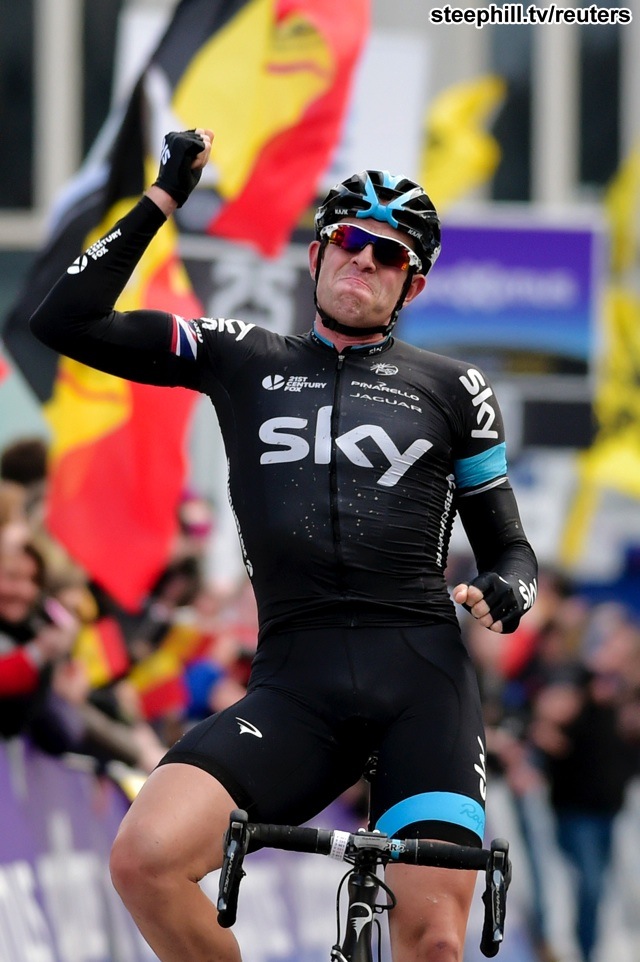
Obviously, EQS did everything right to set up the outcome in their favor. The selection was made with around 40km to go. After an inopportune puncture for Vanmarke, the front group of four riders was established: three EQS riders (Boonen, Terpstra, Vandenbergh) and Stannard for SKY. By all accounts, the odds were stacked greatly in EQS's favor. This tactical situation was further enhanced by the fact that Stybar was sitting on the only threatening chase group.
Either out of overconfidence or concern about being caught from behind, all 3 EQS riders took over the pacemaking, letting Stannard sit on, until around 8km to go. Finally, at 8km, Boonen stopped pulling and started saving energy for his big attack at 4.5km to go. At no point between the split and 4.5km to go, did EQS attack Stannard.
So what could they have done differently?
Work over Stannard - The obvious first choice would be to attack/counterattack Stannard starting at 20-25km out. Ideally, EQS would have sprung a rider and forced Stannard into a work situation. Putting a rider up the road would have forced Stannard to concede the top step or take the front. Under normal circumstances, such a strategy would have worked. However, sometimes the isolated rider is just that strong. Even if ultimately unsuccessful, it would have taken some punch out of Stannard's legs for the finish.
Also, I don't think I would have been too concerned about a catch by the Van Avermaet, Vanmarke, Stybar group. Stybar would have arrived fresh and ready to go in the end game.
Save Boonen - Another option would have been to leave the work to Terpstra and Vandenbergh and let Boonen do the same amount of work as Stannard -- none. At least then Boonen would have been as good as possible for the end game.
Usually, the best approach is to try everything, or in this case at least try something. If there was a plan, it seemed to rely on Boonen riding away solo in the last few km. Even with this plan, it seems like it would have been better to soften Stannard up with a few preliminary attacks from Terpstra and Vandenbergh. At the very least, a few attacks would have helped to assess how strong Stannard was. By allowing him to sit on, EQS really didn't know what they were dealing with and couldn't tweak their end game for the greatest possible chance of success.
Surely, there are relevant details that we as viewers don't know. It goes without saying that these details would have been factored into the EQS game plan. Whether EQS got it right or wrong isn't really that important, unless you just need to feed your ego. Rather, for the mindful racer, the important thing is doing a critical analysis of the tactical game with the information you have available.
30 December 2014
Effect of pedaling rate
I just came across a recent study that addresses a topic of particular interest to me.
Effects of 2 weeks of low‑intensity cycle training with different pedaling rates on the work rate at lactate threshold, Eur J Appl Physiol, http://link.springer.com/article/10.1007/s00421-014-3081-9
This study suggests that training time spent doing low-cadence strength-type workouts is time well spent. In a nutshell, they found that low-cadence workouts at LT power had a greater impact on improvement of work at LT than higher cadence work at the same workload.
Conclusion: "Pedaling rate and the corresponding pedal force and peripheral oxygenation during cycling exercise influence the effect of training at LT on WorkLT. Two weeks of training at a low-frequency pedaling rate (35 rpm), but not at a high-frequency (75 rpm), improved WorkLT."
Unfortunately, the study used untrained individuals and tested cadences that could all be considered low. Also, a longer study period (only 2 weeks?) would have been much better. Arguably, the improvements measured might be attributable entirely to enhanced neuromuscular function that was stimulated more effectively at the higher pedal forces.
Nonetheless, the discussion of how cadence impacts VO2, blood pressure, heart rate, blood lactate, and oxy-hemoglobin/myoglobin concentration at the vastus lateralis is interesting and seems to make sense.
Obviously, this training technique can be taken too far and there is probably some increased risk of injury. However, two factors suggest that the risk of injury is not unreasonable:
- generally, on-the-bike low-cadence work results in lower pedal force, and therefore joint stress, than strength exercises in the gym
- generally, the workouts incorporating low-cadence work, do not result in greater pedal forces than you'll experience during maximal efforts at more typical cadences (sprints, intervals, race efforts)
I would suggest that increased injury risk comes from "overdoing" these workouts in some way.
Of course, there are some studies out there that conclude the opposite or at least find less benefit attributable to this technique.
One such study, Low cadence interval training at moderate intensity does not improve cycling performance in highly trained veteran cyclists (2014), concluded the opposite. I have a hard time buying the conclusion of this study though. Partially because I have some bias or belief that it works, but also because there is no logical reason why it wouldn't at least work just as well as higher cadence efforts at the same workload. Or in other words, how could applying the same central load (aerobic workload) and greater peripheral load (required muscular force), result in diminished improvement? It seems like the authors found that 1+0=2 and 1+1=1. There are some issues with the methodology employed that could have contributed to the result. However, the result still should be considered in evaluating all the evidence.
In any case, these two studies illustrate the difficulties associated with looking at studies of training techniques done in the laboratory for the purpose of publishing an article and trying to translate them into real world training methodologies. On the one hand, the real world is much more complicated. But, at the same time, we are able to apply techniques over a more realistic time period and to our exact set of variables.
Bottom line? In my opinion, formed from personal and coaching experience, and finding support in the scientific literature, this type of work will benefit your riding if done "properly".
Happy Holidays!
In any case, these two studies illustrate the difficulties associated with looking at studies of training techniques done in the laboratory for the purpose of publishing an article and trying to translate them into real world training methodologies. On the one hand, the real world is much more complicated. But, at the same time, we are able to apply techniques over a more realistic time period and to our exact set of variables.
Bottom line? In my opinion, formed from personal and coaching experience, and finding support in the scientific literature, this type of work will benefit your riding if done "properly".
Happy Holidays!
09 December 2014
Protein timing....pfft.
A recent Bicycling article claims that "[c]onsuming protein and after rides can help stave off muscle loss". The article even references a study published in Sports Medicine as support. Unfortunately, there is no link to the study itself so it is difficult to comment on the specific support claimed by the author. However, a quick search of recent scholarly articles across multiple journals tends to conclude the opposite.
A recent meta-analysis in the Journal of the International Society of Sports Nutrition concludes that their study "refute[s] the commonly held belief that the timing of protein intake in and around a training session is critical to muscular adaptations and indicate that consuming adequate protein in combination with resistance exercise is the key factor for maximizing muscle protein accretion." See http://link.springer.com/article/10.1186/1550-2783-9-54 A 2009 study concludes: Results indicate that the time of protein-supplement ingestion in resistance-trained athletes during a 10-wk training program does not provide any added benefit to strength, power, or body-composition changes. See http://www.ncbi.nlm.nih.gov/pubmed/19478342
Of course, protein intake is important. You should be ingesting at least 0.8g protein per kilogram of body weight per day. This is a global consensus figure for the adequate amount to satisfy the protein needs of a healthy adult. There is less agreement as to whether athletes require more protein, and if so, how much. There are negative effects associated with excessive protein consumption (and counter-examples as well), so "more is better and can't hurt" probably doesn't apply. Also, if you are at all concerned about body weight, excessive protein ingestion could contribute to weight gain (assuming you continue to consume the same amount of fat and carbohydrates). Also notable, studies indicate that female athletes tend to under-consume protein as compared to men.
The bottom line, 1.2g/kg/d to 1.6g/kg/d is probably a reasonable range for most training cyclists. Adjust your diet to this range and then stop thinking about it.
As always, caveat lector.
A recent meta-analysis in the Journal of the International Society of Sports Nutrition concludes that their study "refute[s] the commonly held belief that the timing of protein intake in and around a training session is critical to muscular adaptations and indicate that consuming adequate protein in combination with resistance exercise is the key factor for maximizing muscle protein accretion." See http://link.springer.com/article/10.1186/1550-2783-9-54 A 2009 study concludes: Results indicate that the time of protein-supplement ingestion in resistance-trained athletes during a 10-wk training program does not provide any added benefit to strength, power, or body-composition changes. See http://www.ncbi.nlm.nih.gov/pubmed/19478342
Of course, protein intake is important. You should be ingesting at least 0.8g protein per kilogram of body weight per day. This is a global consensus figure for the adequate amount to satisfy the protein needs of a healthy adult. There is less agreement as to whether athletes require more protein, and if so, how much. There are negative effects associated with excessive protein consumption (and counter-examples as well), so "more is better and can't hurt" probably doesn't apply. Also, if you are at all concerned about body weight, excessive protein ingestion could contribute to weight gain (assuming you continue to consume the same amount of fat and carbohydrates). Also notable, studies indicate that female athletes tend to under-consume protein as compared to men.
The bottom line, 1.2g/kg/d to 1.6g/kg/d is probably a reasonable range for most training cyclists. Adjust your diet to this range and then stop thinking about it.
As always, caveat lector.
08 December 2014
Wrapping up 2014
2014 is almost done. Things have been going well, except for posting to this blog!
Here's a few highlights:
The team had a great season winning both the RMCCC Team Title (conference) and National Team Title. We're the first "club team" to win a national team omnium in the last five years in either division and in any discipline! Kind of a big deal, that's 46 consecutive national team omniums (or is it omnia?) won by varsity teams.
Other than that its been a lot of the same: riding, coaching, living the dream in Boulder, CO.
Looking forward to 2015!
Here's a few highlights:
Go Buffs!
I am now the Head Coach for the University of Colorado Boulder Cycling Team and coach all disciplines: Road, Track, MTB, and Cyclocross. It was quite an adventure this fall working with the MTB team. I had to learn a lot new faces and get a handle on the gravity discipline. I had a lot of fun and made some strides towards "professionalizing" or "varsity-izing" the program. This was a learning season for me with MTB, but now I feel like I have a good handle on things.The team had a great season winning both the RMCCC Team Title (conference) and National Team Title. We're the first "club team" to win a national team omnium in the last five years in either division and in any discipline! Kind of a big deal, that's 46 consecutive national team omniums (or is it omnia?) won by varsity teams.
Rapha Gentlemen's Race
I was lucky enough to get included on a team for the Rapha Gentlemen's Race in August. I rode with the Boulder Cycle Sport Team and it was a fun, long day on the bike: 104 miles, 13,000+ft of climbing. Good times! More...Other than that its been a lot of the same: riding, coaching, living the dream in Boulder, CO.
Looking forward to 2015!
05 March 2014
Road Season starting up!
Here we go!
Amy Charity is starting her season in El Salvador this week with 3 one-day races and the Vuelta El Salvador (6-day stage race).
The University of Colorado (Go Buffs!) road team is also starting up this weekend with a criterium at Denver University.
Amy Charity is starting her season in El Salvador this week with 3 one-day races and the Vuelta El Salvador (6-day stage race).
The University of Colorado (Go Buffs!) road team is also starting up this weekend with a criterium at Denver University.
28 February 2014
Boulder Cycle Sport
One new development is that I will be the Road Ambassador / Team Leader for the Boulder Cycle Sport Racing Team. Team BCS is best known for its commitment to cyclocross. In 2014, the goal is to apply this very successful model to the road and MTB. Pete Webber will be leading the MTB team.
For more info check out: http://www.bouldercyclesport.com/join-race-team/
We will be having a kick off meeting in mid-March, look forward to seeing you there!
For more info check out: http://www.bouldercyclesport.com/join-race-team/
We will be having a kick off meeting in mid-March, look forward to seeing you there!
Back on track for 2014
Lot's of changes since last post...
I am no longer working at FasCat Coaching, however, I continue to coach full-time as my own entity: Winkler Cycling. I enjoyed my time at FasCat and working with all my athletes, but I needed to make a few changes. I have a much clearer idea about my strengths as a coach and what "kind" of coach I want to be. Also, I needed a little free time to tackle a few side projects.
In 2014, I am committed to keep this blog current with posts related to coaching and bicycle racing. I'll probably minimize postings about my own training and racing. However, I will have to post a race report on Dirty Kanza this year. That should be quite the adventure!
I am no longer working at FasCat Coaching, however, I continue to coach full-time as my own entity: Winkler Cycling. I enjoyed my time at FasCat and working with all my athletes, but I needed to make a few changes. I have a much clearer idea about my strengths as a coach and what "kind" of coach I want to be. Also, I needed a little free time to tackle a few side projects.
In 2014, I am committed to keep this blog current with posts related to coaching and bicycle racing. I'll probably minimize postings about my own training and racing. However, I will have to post a race report on Dirty Kanza this year. That should be quite the adventure!
30 October 2012
Big Boulder CX Weekend
This past weekend was the big race weekend of the season in Boulder with 2 UCI races. Saturday was the Colorado Cross Classic at the Boulder Reservoir and Sunday was the Boulder Cup at Valmont Bike Park.
We had over 5 inches of snow on Wed/Thu so there was some moisture to deal with as the snow melted on Friday. Saturday had some mud, but Sunday was mostly dry.
I've been training pretty hard and took two days off before the weekend. This left me a little flat on Saturday and the result showed it. I decided to race these two races as 35+ instead of 45+. The level of competition in 45+ is solid, but 35+ is a couple notches up and probably deeper. The field was stacked as any 35+ guys wanting to ride Worlds avoided the UCI race.
The short story was that I was not ready to be as aggressive as necessary off the start and ended up way back after the first 2 turns. I also had some trouble with mud buildup on my shoes and a couple slow remounts on the first lap put me even further back. I was way off the front of the race, and I just tried to get into a hard rhythm and hope to move up over the course of the race. I felt like I was working hard enough, but I didn't seem to be making too much progress towards the front. I guess I picked off a few guys here and there because I eventually made it up to 10th by the end. Not too bad, but I couldn't help but think I should have done better.
Sunday was better. It was basically the same field with the absence of Brandon Dwight and Russell Stevenson (1st & 2nd from Saturday). There was still plenty of depth int he field though!
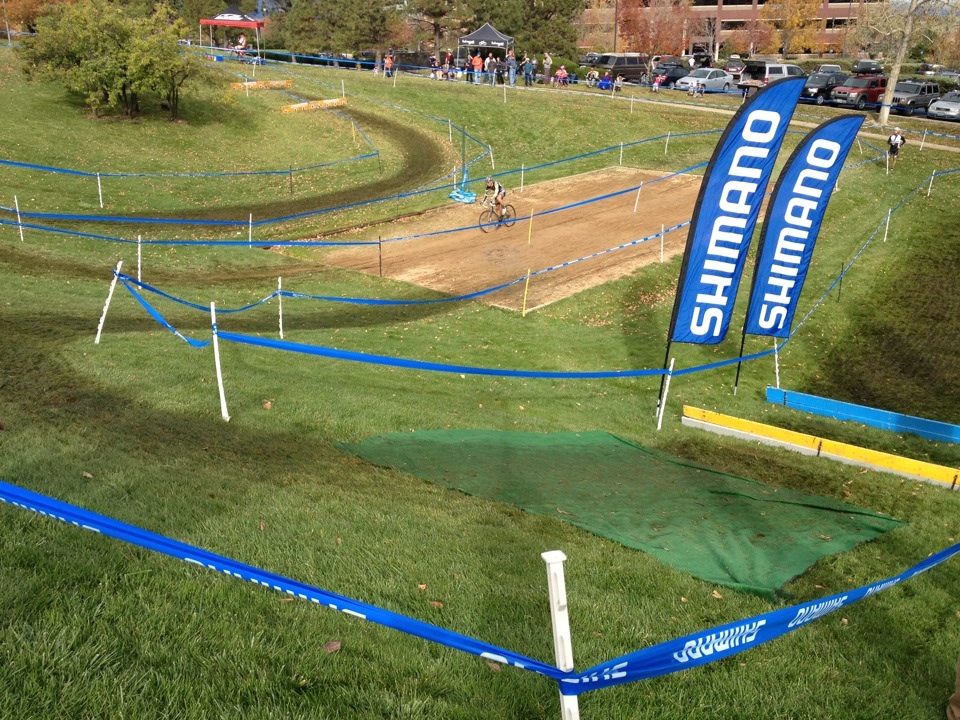
I ended up getting a better start, but still got pushed back in the first sand pit because of some poor riding by others. I don't like to complain about other riders, but it just doesn't make any sense to me. Too many guys try to cram into bad lines and create massive congestion. This really doesn't help anyone's cause. It is much better to just stay single-file on the best line. This way everyone stays connected to the leaders and you can move up as gaps start to open in the line. Its just like on the road where everyone rides the gutter in crosswinds instead of forming echelons. I suppose its useless to complain, it will probably never change.
Finally things started to shuffle out and I started moving up. I made my best progress on the hill, but seemed to be leap-frogging riders all the way around. Finally, I was looking good, riding with some good names in the top 6. By the stairs on the last lap I actually made it up to 2nd place's wheel. However, I then proceeded to make a few mistakes, including a fall, which slipped me back to 4th place.
I'm satisfied. Need to keep the nose to the grindstone for the next 2 months and continue to build toward Nationals and Worlds.
We had over 5 inches of snow on Wed/Thu so there was some moisture to deal with as the snow melted on Friday. Saturday had some mud, but Sunday was mostly dry.
I've been training pretty hard and took two days off before the weekend. This left me a little flat on Saturday and the result showed it. I decided to race these two races as 35+ instead of 45+. The level of competition in 45+ is solid, but 35+ is a couple notches up and probably deeper. The field was stacked as any 35+ guys wanting to ride Worlds avoided the UCI race.
The short story was that I was not ready to be as aggressive as necessary off the start and ended up way back after the first 2 turns. I also had some trouble with mud buildup on my shoes and a couple slow remounts on the first lap put me even further back. I was way off the front of the race, and I just tried to get into a hard rhythm and hope to move up over the course of the race. I felt like I was working hard enough, but I didn't seem to be making too much progress towards the front. I guess I picked off a few guys here and there because I eventually made it up to 10th by the end. Not too bad, but I couldn't help but think I should have done better.
![]() |
| The big sand pit at the Colorado Cross Classic |
Sunday was better. It was basically the same field with the absence of Brandon Dwight and Russell Stevenson (1st & 2nd from Saturday). There was still plenty of depth int he field though!
I ended up getting a better start, but still got pushed back in the first sand pit because of some poor riding by others. I don't like to complain about other riders, but it just doesn't make any sense to me. Too many guys try to cram into bad lines and create massive congestion. This really doesn't help anyone's cause. It is much better to just stay single-file on the best line. This way everyone stays connected to the leaders and you can move up as gaps start to open in the line. Its just like on the road where everyone rides the gutter in crosswinds instead of forming echelons. I suppose its useless to complain, it will probably never change.
Finally things started to shuffle out and I started moving up. I made my best progress on the hill, but seemed to be leap-frogging riders all the way around. Finally, I was looking good, riding with some good names in the top 6. By the stairs on the last lap I actually made it up to 2nd place's wheel. However, I then proceeded to make a few mistakes, including a fall, which slipped me back to 4th place.
I'm satisfied. Need to keep the nose to the grindstone for the next 2 months and continue to build toward Nationals and Worlds.
25 October 2012
Interlocken BR #3
A little late on the report...
Raced on Saturday last weekend. The weather was almost perfect, upper 60s and partly sunny. The race should have been dry and fast, but someone ran the sprinklers the night and morning before...so we had a muddy race without any rain!
It was a fun course, with some interesting features. The moisture turn the thick grass pretty boggy in sections and this probably defined the course and the race outcome.
I have now established my front row status in the 45+ field, thanks to some good results. So, I got off the line in decent position allowed myself to just ease into the race. I bobbled the corner right before the barriers in the picture above, which put me back to about 7th or 8th. I didn't panic and just watched to make sure the group was staying connected to the front runners. Tim Godby ended up setting pace for 2 laps and no one would come by him.
Our race was to be 6 laps. I had moved up a few spots over the first 2 laps and after the start/finish I put in an acceleration. I planned to gas it through the section in the photo above and through the backside bog before taking stock of how the group responded. Apparently, no one tried to chase me because I was on my own. I settled into a hard rhythm and tried to time my passes around the lapped riders. I wasn't getting any clear time gaps, so I wasn't sure how close everyone was and how vigorous the chase was. As it turns out, I was extending my lead about 10-15 seconds per lap. Ultimately, I was able to cruise in for the win after 6 laps. It was a hard effort, as any Cx race is, but it always seems relatively easy when no one is nipping at your heels.
This keeps me in the lead of the Boulder Racing Series with 2 races to go. I'm starting to look ahead to Nationals and Worlds and I need to take my fitness up a couple notches. To that end, I will race this coming weekend in the 35+ races (Colorado Cross Cup and Boulder Cup). After that, I'll probably try my luck in the Open races.
Raced on Saturday last weekend. The weather was almost perfect, upper 60s and partly sunny. The race should have been dry and fast, but someone ran the sprinklers the night and morning before...so we had a muddy race without any rain!
It was a fun course, with some interesting features. The moisture turn the thick grass pretty boggy in sections and this probably defined the course and the race outcome.
I have now established my front row status in the 45+ field, thanks to some good results. So, I got off the line in decent position allowed myself to just ease into the race. I bobbled the corner right before the barriers in the picture above, which put me back to about 7th or 8th. I didn't panic and just watched to make sure the group was staying connected to the front runners. Tim Godby ended up setting pace for 2 laps and no one would come by him.
Our race was to be 6 laps. I had moved up a few spots over the first 2 laps and after the start/finish I put in an acceleration. I planned to gas it through the section in the photo above and through the backside bog before taking stock of how the group responded. Apparently, no one tried to chase me because I was on my own. I settled into a hard rhythm and tried to time my passes around the lapped riders. I wasn't getting any clear time gaps, so I wasn't sure how close everyone was and how vigorous the chase was. As it turns out, I was extending my lead about 10-15 seconds per lap. Ultimately, I was able to cruise in for the win after 6 laps. It was a hard effort, as any Cx race is, but it always seems relatively easy when no one is nipping at your heels.
This keeps me in the lead of the Boulder Racing Series with 2 races to go. I'm starting to look ahead to Nationals and Worlds and I need to take my fitness up a couple notches. To that end, I will race this coming weekend in the 35+ races (Colorado Cross Cup and Boulder Cup). After that, I'll probably try my luck in the Open races.
![]() |
| Apparently EVERYONE is getting outed for doping! |
15 October 2012
The SmartWool Cup - USGP Fort Collins
Big time cyclocross comes to the Front Range!
Fort Collins was host to the latest USGP race this past weekend. I have only ever done the Louisville race so this was a first for me.
I registered early so I was at least assured of a third row start. But, I did my homework and raced enough local races to be in the first 8 riders (I was 8th) in our local Colorado Cup Series. This got me a call-up immediately after anyone with USGP points from Madison. Lucky number 13, second row! As good as this was, it was still not an automatic route to a good wheel off the start. But, hey it was better than 8th row!
On Saturday we had cool temps and rain. Full-on slippery muddy conditions prevailed. As it turned out we were the only race with these conditions. It essentially rained throughout our race then stopped. The 35+ race had improving conditions while they raced. By the time the pros raced the course was tacky and smooth.
I got off to a decent start somewhere between 5th and 10th. Then on the second downhill turn there was a big pileup on the inside. Luckily I was in a position to skirt it and slipped up to third spot. I got stuck behind a guy named Tim Butler who was struggling in the corners while on the front Mark Legg was starting to ride away. I finally managed to get around Butler and set about closing the gap to Legg. I eventually did, but it wasn't to last. I ended up getting taken out in traffic as we started catching juniors early on. That pretty much did it. Legg got a gap and I would never get it going well enough to bring him back.
Meanwhile, Jon Cariveau had caught up and passed me. I was able to stay with him and as the race progressed I start to feel stronger. I was riding pretty sloppy and was probably losing little bits of time all over the place. But the biggie was going down 3 times in 2 laps. I would pass Cariveau then proceed to slide out or make some other bobble and he would pass me back. This happened 3 times on the 3rd and 2nd to last laps. Finally, I put the gas down going into the last lap and kept it together for a full lap. This was enough to get about 12 seconds on Cariveau and close to 20 seconds on Legg. Good enough for 2nd place. I'll take it, but I've got some work to do!
Sunday was almost a repeat, but with dry fast conditions. I did manage to keep the rubber side down at least. I had the same start position and managed to work myself into 3rd again somewhere on the 2nd lap. As on Saturday, Legg was away with a gap of 15-20 seconds already. I moved clear into 2nd place for the rest of the day but was never able to make any serious inroads into Legg's gap. I think it stretched to as large as almost 40 seconds, but I brought back a little on the last two laps and finished back 27 seconds.
The podiums was the same both days: Legg, Me, Cariveau.
This weekend was a fairly stacked field so I have a good read on where I stand relative to my competition for Nationals and Worlds. Time to get to work and move up a couple notches for January!
Fort Collins was host to the latest USGP race this past weekend. I have only ever done the Louisville race so this was a first for me.
I registered early so I was at least assured of a third row start. But, I did my homework and raced enough local races to be in the first 8 riders (I was 8th) in our local Colorado Cup Series. This got me a call-up immediately after anyone with USGP points from Madison. Lucky number 13, second row! As good as this was, it was still not an automatic route to a good wheel off the start. But, hey it was better than 8th row!
On Saturday we had cool temps and rain. Full-on slippery muddy conditions prevailed. As it turned out we were the only race with these conditions. It essentially rained throughout our race then stopped. The 35+ race had improving conditions while they raced. By the time the pros raced the course was tacky and smooth.
I got off to a decent start somewhere between 5th and 10th. Then on the second downhill turn there was a big pileup on the inside. Luckily I was in a position to skirt it and slipped up to third spot. I got stuck behind a guy named Tim Butler who was struggling in the corners while on the front Mark Legg was starting to ride away. I finally managed to get around Butler and set about closing the gap to Legg. I eventually did, but it wasn't to last. I ended up getting taken out in traffic as we started catching juniors early on. That pretty much did it. Legg got a gap and I would never get it going well enough to bring him back.
Meanwhile, Jon Cariveau had caught up and passed me. I was able to stay with him and as the race progressed I start to feel stronger. I was riding pretty sloppy and was probably losing little bits of time all over the place. But the biggie was going down 3 times in 2 laps. I would pass Cariveau then proceed to slide out or make some other bobble and he would pass me back. This happened 3 times on the 3rd and 2nd to last laps. Finally, I put the gas down going into the last lap and kept it together for a full lap. This was enough to get about 12 seconds on Cariveau and close to 20 seconds on Legg. Good enough for 2nd place. I'll take it, but I've got some work to do!
Sunday was almost a repeat, but with dry fast conditions. I did manage to keep the rubber side down at least. I had the same start position and managed to work myself into 3rd again somewhere on the 2nd lap. As on Saturday, Legg was away with a gap of 15-20 seconds already. I moved clear into 2nd place for the rest of the day but was never able to make any serious inroads into Legg's gap. I think it stretched to as large as almost 40 seconds, but I brought back a little on the last two laps and finished back 27 seconds.
The podiums was the same both days: Legg, Me, Cariveau.
This weekend was a fairly stacked field so I have a good read on where I stand relative to my competition for Nationals and Worlds. Time to get to work and move up a couple notches for January!
Subscribe to:
Posts (Atom)


.jpeg)